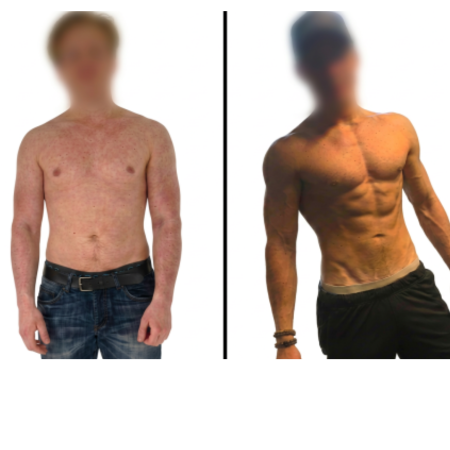
How to Transform from Skinny Fat to Muscular: 3 Science-Backed Strategies for Long-Term Fat Loss
If you’ve set a goal to lose fat and get lean this year, you’re certainly not alone. Many of us are actively trying to improve our body composition, specifically looking to transform from skinny fat to muscular. However, if you follow fitness content, you’ve probably heard a daunting statistic: most diets fail over the long term.
And unfortunately, it’s true.
Take the famous study on The Biggest Loser contestants. Researchers followed up with 14 participants six years after the 2009 season ended. The results? Only one person had kept the weight off. Five had regained everything, and two ended up heavier than before the show started. Similarly, a 2020 systematic review of eight weight loss studies showed that while all induced weight loss initially, participants experienced average weight regain—sometimes overshooting their starting weight—once the diets ended.
Getting lean for a temporary event (like a wedding or vacation) requires a completely different mindset and strategy than getting lean and staying lean. If your true goal is to ditch the skinny fat look for good, you need a sustainable approach.
Here is the ultimate guide to understanding how fat loss works, avoiding the crash-diet trap, and utilizing three long-term strategies to transform from skinny fat to muscular permanently.
The Basics: How Fat Loss (and Metabolic Adaptation) Actually Works
Before diving into long-term strategies, we need to understand the mechanics of fat loss. Fat loss occurs solely through a caloric deficit—consuming fewer calories than your body burns.
You burn calories in four primary ways:
- Resting Energy Expenditure (REE): The calories your body burns just to stay alive (heartbeat, breathing).
- Exercise Activity Thermogenesis (EAT): The calories burned during workouts.
- Non-Exercise Activity Thermogenesis (NEAT): The calories burned doing daily movements (walking, typing, fidgeting).
- Thermic Effect of Food (TEF): The calories burned digesting your food.
If your total daily energy expenditure is 2,500 calories and you only eat 2,000 calories, you are in a 500-calorie deficit. Sustained over time, this typically results in about one pound of fat loss per week.
The Catch: Metabolic Adaptation
Here is the crucial element many people miss: as you lose weight, the number of calories you burn decreases. Because your body is getting smaller, your REE drops. Because you have less energy, your NEAT drops. Because you’re eating less, your TEF drops.
This means your initial 500-calorie deficit might not be a deficit at all a few months down the line. To account for this, you have to either slightly lower your calories again or simply accept a slower rate of weight loss.
The Rule of 3 for Body Composition
If you want to genuinely transform from skinny fat to muscular rather than just becoming a smaller version of yourself, your routine must include three things:
- A sustained caloric deficit (to burn fat).
- Weight training (to stimulate muscle retention/growth).
- Adequate protein (aim for 0.7 to 1 gram per pound of body weight to support muscle mass).
Crash diets might make the scale drop fast, but they eat away at your muscle mass, which is the primary cause of a skinny fat physique. To avoid this, follow these three long-term strategies.
Strategy 1: Diet Slowly (Make It Feel Like You Aren’t Dieting)
The most sustainable way to transform from skinny fat to muscular is to take your time. The general science-based rule is to aim for a weight loss of 0.5% to 1% of your body weight per week.
If you weigh 200 pounds, that’s 1 to 2 pounds per week. However, going even slower has incredible psychological and physiological benefits.
By aiming for roughly a half-pound a week, the diet feels remarkably easy. You can still eat out, enjoy foods you love, and maintain your social life. This slower pace prevents you from feeling deprived, meaning you won’t be desperate to binge once the diet ends.
How to do it:
- Set a caloric deficit around 20% below your current maintenance.
- Zoom out on the scale. Minor spikes from vacations or holidays are normal. Focus on the long-term downward trend.
- Set a realistic end goal. Most men can comfortably maintain 10% to 20% body fat, while women generally maintain between 18% and 28% body fat. Pushing your body beneath its genetic set point will plummet your energy, mood, and libido.
Strategy 2: Put Fat Loss on Autopilot with Habit Building
Motivation is fleeting. No matter how fired up you are today, there will be days when you want to quit. To permanently beat the skinny fat curse, you need habits that carry you through low-motivation days.
Here are two science-based techniques to build bulletproof habits:
1. Temptation Bundling
Pair an activity you want to do with a habit you need to do for your fat loss goals.
Example: If you hate doing cardio but love true crime podcasts, only allow yourself to listen to those podcasts while you’re on the treadmill. If you struggle to meal prep on Sundays, put on your favorite YouTube channels while you cook.
2. Environment Alignment
Design your surroundings to make good choices easy and bad choices hard.
- If you constantly overeat a specific junk food, stop bringing it into the house.
- If you stress-eat at night, keep alternative stress relievers (like puzzles, books, or video games) in the kitchen.
- If late-night doomscrolling makes you skip morning workouts, leave your phone in another room and use an old-school alarm clock.
Strategy 3: Have a Smart Post-Diet Plan
This is the most neglected step in fitness. Once people successfully transform from skinny fat to muscular, they often have no idea what to do next.
If you don’t have a plan, you will likely revert to old eating habits and regain the weight. Conversely, some people fall into the trap of “meticulous reverse dieting”—spending months slowly adding 50 calories a week back into their diet. This unnecessarily prolongs the diet mindset and keeps you hungry.
The straightforward post-diet solution:
- Jump straight to maintenance: If you are done losing weight, stop eating in a deficit! Immediately boost your calories up by 200 to 600 calories (back to your new maintenance level).
- Treat maintenance as a dynamic range: Your maintenance isn’t one exact number. It’s a range (e.g., 2,600 to 3,000 calories). Slowly push your calories toward the top of that range as long as your weight remains relatively stable.
- Keep tracking your weight: Regular weigh-ins (2-3 times a week) keep you accountable and are scientifically linked to better long-term weight maintenance.
More food means better training performance, which is exactly what you need to keep building muscle and finalize your goal to transform from skinny fat to muscular.
Need a Tool to Keep You on Track?
Taking the guesswork out of your caloric needs is one of the biggest hacks for long-term success. Nutrition apps like Macrofactor act as algorithmic nutrition coaches, adjusting your weekly targets based on your metabolism rather than just logging your food. Uniquely, it offers a “dynamic maintenance mode” to help you keep your weight stable within a two-pound range once you finish your cut—perfect for solidifying your new, leaner physique.




Leave a Reply